


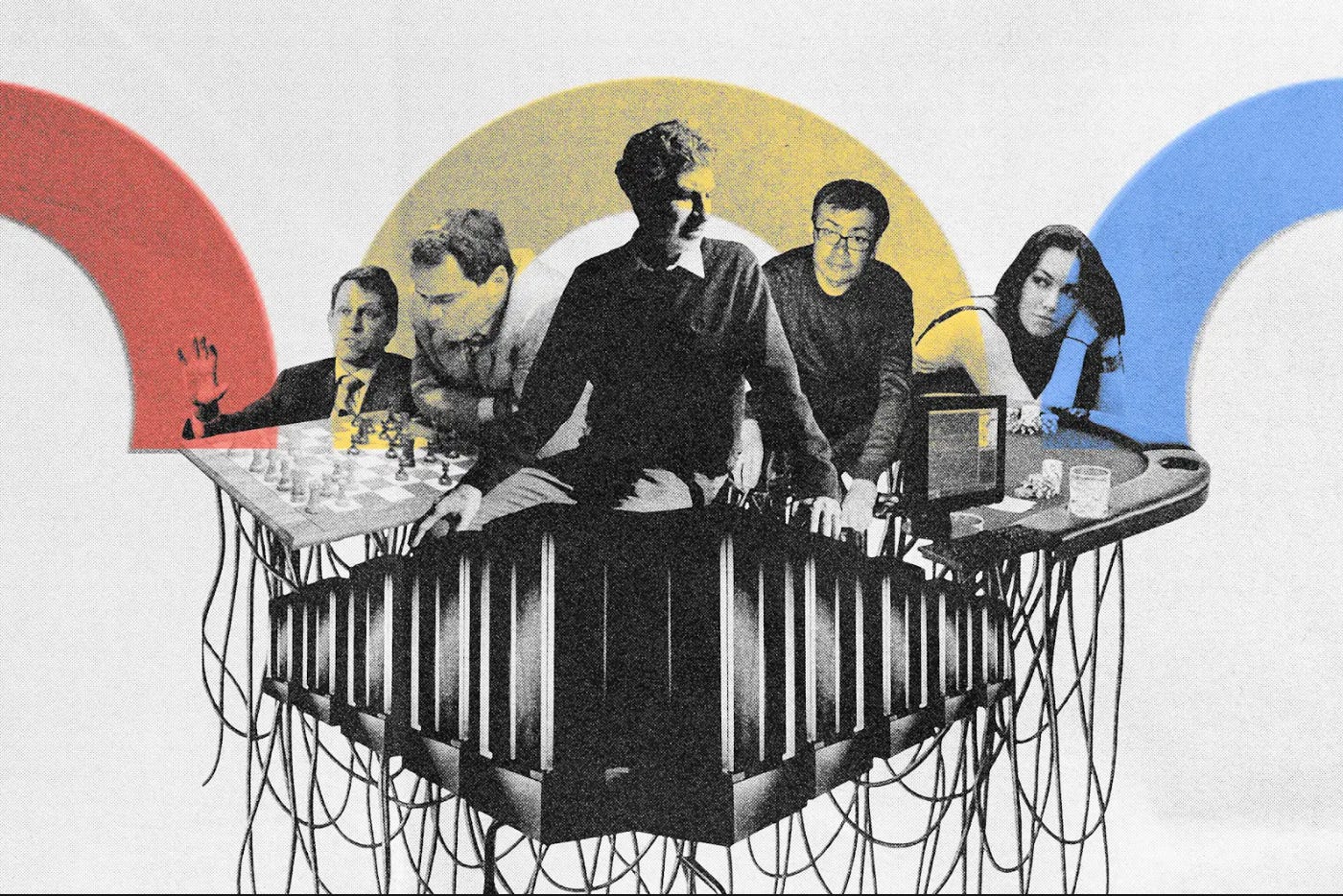
What if the path to a true thinking machine was found not just in a lab… but in a game? For decades, AI’s greatest triumphs came from games: checkers, chess, Jeopardy. But no matter how many trophies it took from humans, it still couldn’t think. In this episode, we follow the contrarian scientists who refused to give up on a radical idea, one that would ultimately change how machines learn. But their breakthrough came with a cost: incredible performance, at the expense of understanding how it actually works.
This episode features:
Yoshua Bengio, Liv Boeree, Geoffrey Hinton, Karen Hao, Keach Hagey, Jasmine Sun
Available to listen on Apple and Spotify
Here’s the Transcript!
Gregory Warner:
This is the last invention. I’m Gregory Warner.
News Coverage:
Kasparov has played Knight b8 to d7, which is a move that his arch rival, Anatoly Karpov.
Gregory Warner:
On a spring day in 1997. Millions of people around the world, myself included, watched one of the most unusual chess matches in history.
News Coverage:
In one corner, weighing 176 pounds, considered by many the greatest player in the history of the game…
Gregory Warner:
A battle between the world’s reigning champion, Garry Kasparov.
News Coverage:
And in the other corner, weighing 1.4 tons, the new and improved RS 6000 SP supercomputer.
Gregory Warner:
And the IBM supercomputer created to beat him: Deep Blue.
News Coverage:
the battle of man against machine.
News Coverage:
First move of this epic six game has been played. Deep blue has played E2 to E4
Gregory Warner:
Now the reason it was getting so much attention, even from a lot of people who usually are not into chess.
News Coverage:
For some, watching chess might be tantamount to watching paint dry. However, it’s actually been very entertaining.
News Coverage:
Look at Garry. That jacket opened up a little bit there.
Gregory Warner:
Wait, was the fact that Garry Kasparov wasn’t just another world chess champion? He was the world champion. And at this time in history, he had never lost a single championship match.
WHO IS THIS?
So challenging Kasparov in any way. I mean, he’s the pinnacle of chess. He used incredible genius.
Gregory Warner:
And on the other side of the board, IBM had invested millions of dollars and years of research into creating Deep Blue. They had specially designed chips that could analyze up to 200 million different chess positions per second. And they said that they were finally ready to take on the very best human at this game that in many ways has become a symbol of human intelligence.
News Coverage:
And now there’s all kinds of problems. Notice that this bishop on c6, the bishop, can easily fall victim to what we call an overload tactic…
Gregory Warner:
And this game was intense. I remember watching it on TV at the time, looking at Kasparov, running his hand through his hair, getting up, walking around the room, coming back to the board, concentrating on each and every move he made while the machine was just this glowing screen, very methodical, making its moves quickly and decisively.
News Coverage:
He looks disgusted. In fact, he looks just like he can’t believe what’s going on right now is an unhappy camper.
Gregory Warner:
And in the final match, our human champion fell into a trap.
News Coverage:
And wow! Kasparov has resigned.
News Coverage: In an absolutely stunning, stunning 19 mover, Kasparov has just simply stormed away.
News Coverage:
Machine didn’t just beat man, but trounced him.
News Coverage:
Newsweek magazine called it the brain’s last stand.
News Coverage:
The game of chess, supposedly a true test of human intellect, will never be the same again.
Gregory Warner:
Now, for a while, it did feel like we were witnessing a moment of profound change.
News Coverage:
Call it a blow against humanity.
News Coverage:
The victory seemed to raise all those old fears of superhuman machines, crushing the human spirit.
Gregory Warner:
But pretty quickly. While, it was a very impressive feat that the programmers at IBM had pulled off. It wasn’t actually transformative. I mean, it didn’t really change chess. In the years since, chess has only become more popular, both in the amount of chess people are playing and the viewership of chess competitions. Human to human. And in the world outside of chess, this did not usher in an age of competition between humans and true thinking machines. And while some of us looked at this and shrugged, or perhaps breathed a sigh of relief, there were those who looked at this moment and thought we were playing the wrong game.
Demis Hassabis:
Although I was fascinated by these early chess programs that they could do that, I was also slightly disappointed by them because Deep Blue, even though is was the pinnacle of AI at the time, it did not seem intelligent.
Yoshua Bengio:
That way. That deep blue beat Kasparov was nothing like how human chess players do it.
Demis Hassabis:
I was actually more impressed with Kasparov’s mind than I was with the machine, because he was this brute of a machine, all it can do is play chess, but it couldn’t even play Tic-Tac-Toe. And then Kasparov can play chess, but also can do all the other things that humans can do, so I thought, you know, it does not speak to the wonderfulness of the human mind?
Gregory Warner:
For today. The games and the gamers that brought us the AI revolution and the small band of contrarian scientists determined to make an AI that didn’t think like a machine.
Gregory Warner:
Okay, Andy Mills.
Andy Mills:
Gregory Warner.
Gregory Warner:
Let’s talk about games.
Liv Boeree:
I actually think one of the interesting ways of following the path of AI is funny enough, through games.
Andy Mills:
So I originally got into this connection between games and the history of AI through Liv Boeree.
Liv Boeree:
My name is Liv Boeree, and I used to be a professional poker player for a long time. My original background is actually in physics.
Andy Mills:
She herself is very good at games. She’s famous for being a world champion poker player.
Gregory Warner:
We met her in episode one. Right?
Andy Mills:
Yeah. She spent a good chunk of the last decade publicly advocating for AI safety. And that’s in part because she’s not just a game player, but she’s a game theorist.
Liv Boeree:
Being able to solve a game is being able to understand a particular environment where you have different objectives, different scoring metrics. Perhaps the environment can be changing and being able to adapt in order to be the best at that goal. So as artificial intelligence gets better at game theory, essentially in increasingly complex and increasingly real life environments, then they are getting better at navigating the world. And that’s really the trajectory we’re seeing. When you hear people talk about AGI, this idea of artificial general intelligence, what they’re really saying is an agent that is as good as a human generally is at navigating all of the different things in this world that we live in.
Gregory Warner:
So on the one hand, games are this very practical kind of benchmark, right? Like just a way for computer scientists to test how their system is doing. But as the games get more and more complex, they are getting closer to that holy grail of a thinking machine.
Andy Mills:
Yeah, that’s the idea. And it goes back all the way to the 1950s to the first generation of AI researchers.
Liv Boeree:
Some of the earliest computer programs were built to try and play basic games.
Archival Tape:
Tomorrow a preview of the future as it begins to take shape in the laboratories of the world.
Andy Mills:
One of the earliest ones came from the UK. It was a system that played tic tac toe, but because it was the UK, they called it noughts and crosses.
Archival Tape: In his spare time, engineer D.W. Davies built an automatic noughts and crosses machine that thinks for itself. By its own effort, it selects from the 6045 alternatives, the one that always wins.
Liv Boeree:
And then over the rest of the 20th century and into the 21st century, we saw games of increasingly more complexity be defeated by computers to the point of superhuman level.
Andy Mills:
Fast forward to the 1970s. You’ve got an AI system that can play checkers.
Archival Tape: That man isn’t playing checkers against a computer, is he? Sure. And it plays pretty well sometimes, even better than the man who designed them.
Andy Mills:
After that comes backgammon. Then in the 90s, you get the famous chess match.
News Coverage:
IBM’s deep blue computer demolished the greatest chess player ever, Garry Kasparov in the final and decisive game of their match.
Andy Mills:
And then by the time you get to 2011, you’ve got an AI system that challenged humans to what was seen at the time as the most ambitious game yet.
Jeopardy! Tape:
This is jeopardy! The IBM challenge. And now here is the host of Jeopardy! Alex Trebek.
Andy Mills:
So IBM, they’re back again, and they’re doubling down on the same strategy that they used with Deep Blue to win in chess. They’ve poured millions of dollars and years of research into winning Jeopardy! Because as they see it, this is an even more complicated challenge for an artificial intelligence.
IBM Watson Documentary:
Language is an area where, from the very beginning of the computer era, people kept expecting computers to do reasonably well at. They expected computers could talk. And so far the computers have failed to deliver on this promise.
Andy Mills:
On top of having to answer questions on any different subject, you know, history, pop culture, philosophy. This system will have to speak and understand language.
Alex Trebek:
A little over three years ago, the folks at IBM came to us with a proposal that they considered to be the next grand challenge in computing, and that was designing a computer system that could understand the complexities of natural language well enough to compete against Jeopardy’s best players.
Andy Mills:
Jeopardy! and IBM, they hype up this big three night showdown.
Alex Trebek:
So you are about to witness what may prove to be an historic competition, an exhibition…
Andy Mills:
Where the AI system, Watson is going to go head to head against two of the best players in Jeopardy! history.
Alex Trebek:
Ladies and gentlemen, this is Watson. Let’s play jeopardy! Here we go.
Andy Mills:
And the first things start off a bit rocky for Watson. The human players, they’re neck and neck.
Alex Trebek:
Stylish elegance. Or students who all graduated in the same year. Watson
Watson:
What is chic?
Alex Trebek:
No, sorry.
Brad Rutter:
What is class?
Alex Trebek:
Class. You got it.
Andy Mills:
But by the second night of this three night special.
Alex Trebek:
And any time you feel the pain, hey, this guy, refrain, don’t carry the world upon your shoulders. Watson.
Watson:
Who is Jude?
Alex Trebek:
Yes.
Andy Mills:
Watson starts crushing the humans.
Alex Trebek:
Losing to him by 100th of a second. Watson?
Watson:
Who is Michael Phelps?
Alex Trebek: Yes. Black holes boundary from which matter cannot escape. Watson.
Watson:
What is event horizon?
Alex Trebek:
Yes. Watson.
Watson:
Who is Grendel?
Alex Trebek:
Yes, Watson.
Watson:
What is The Last Judgment?
Alex Trebek:
Correct.
Watson:
What is London?
Alex Trebek:
Correct.
Watson:
What is a stick?
Alex Trebek:
Stick is right. And with that you add your lead. You’re at 5000…
Andy Mills:
And just like with Deep Blue beating the world’s best chess player, there was this moment afterwards where it felt like we might really be witnessing some kind of milestone.
News Coverage:
IBM says the technology could help speed up medical diagnosis and other challenging…
Andy Mills:
IBM, they put out this documentary saying this is going to be transformational. All these things are now going to be possible.
IBM Watson Documentary:
Of course, this whole project is not ultimately about playing Jeopardy! It’s about doing research in deep analytics and in natural language understanding. This is about taking the technology and applying it to solve problems people really care about. We’re just so excited about all the things we can do with this.
Andy Mills:
But again, just like with Deep Blue, the strategy was very good at winning a complicated game, but it failed to live up to the hype. It failed to lead to anything very useful outside of the world of that game.
Gregory Warner:
Okay, so you’re saying that for decades, computer scientists were testing their AI systems against the world of games under the theory that as the games got more complex and as the skills they had to program in became more interesting, that somehow those skills would translate into the real world. And yet, none of these AI systems that can play these games can make the jump into real life.
Andy Mills:
Yeah, they can’t make that jump that Liv Boeree was talking about
Gregory Warner:
Their intelligence does not transcend into the real world.
Andy Mills:
Exactly.
Gregory Warner:
And what is the theory for why?
Andy Mills:
Well, it comes down to the strategy, to the way that these AI systems were built to win in these different games, which relies on a massive amount of engineering. Deep blue, for example, was programmed essentially hand coded with all the rules of chess. With the millions and millions of possible chess positions they might encounter coming from all the world’s best chess books. Or the same with Watson. It’s programed on all these encyclopedias, and then during the game, they’re essentially just running algorithms to try and retrieve the possible right answer or the possible right move as fast as they can. And do you remember what were you thinking back in 1997, when Garry Kasparov gets beat by IBM’s Deep Blue and there’s all this excitement about what’s going to happen next?
Yoshua Bengio:
Nothing much, because we knew that it was just brute force search, which is a classical AI technique that is very unlike human intelligence.
Andy Mills:
But it turns out that all of this time, that all the attention was being paid to Watson and Deep Blue, there were some AI researchers like Yoshua Bengio…
Yoshua Bengio:
That way that Deep Blue beat Kasparov was nothing like how human chess players do it.
Andy Mills:
And this small band of AI researcher outsiders who were essentially shaking their heads, saying that these AI systems, they are not doing what anyone would consider thinking, and they thought that they had a better way. Would you describe yourself as a bit of a contrarian?
Geoffrey Hinton:
I’m tempted to disagree with that, but I think you might be right.
Andy Mills:
And one of them that would turn out to be the most consequential was a guy named Geoffrey Hinton. Well, let’s just get into it. First off, can you just introduce yourself? You know, what’s your name and what title do you go by these days?
Geoffrey Hinton:
My name is Geoffrey Hinton. I’ve been doing research on neural networks since 1972. That’s a little over 50 years. And for a long time, this was regarded as crazy. And more recently, it’s turned out it works much better than symbolic AI.
Gregory Warner:
This is the same Geoffrey Hinton who quit his job at Google in 2023, very publicly to warn the world about the existential risk of AI.
Andy Mills:
Yes, it is. He is now a Nobel Prize winner for his work on artificial intelligence. Many call him the godfather of AI. But before he quit his job at Google, before he even had his job at Google, for much of Hinton’s career, his ideas, his strategies, his approach was resoundingly rejected by almost all of his peers.
Geoffrey Hinton:
I had a very smart student, wanted to do graduate work with me, and one of the other professors in my department told me, oh, don’t work with Hinton. That’ll be the end of your career, it’s dead end.
Andy Mills:
I’m sorry to laugh. I just know what happens at the end of the story. It makes it ridiculous. But what did that feel like at the time?
Geoffrey Hinton:
My view is you shouldn’t give up on an idea that goes against the grain until you understand why it’s wrong.
Karen Hao:
So, Hinton, he initially started as kind of ostracized by the AI community because he was working on the approach that most people thought was a dud.
Andy Mills:
Unsurprisingly, Hinton’s name and his backstory came up in almost every conversation that I had for the series, including with the author, Karen Hao.
Karen Hao:
He just felt very strongly about it, in part because he originally started studying AI, not because he wanted to recreate human intelligence, but actually because he wanted to understand human intelligence better. So he was interested in that from the perspective of: if we successfully create intelligent systems in computers, that will enable us to better understand our own intelligence.
Andy Mills:
And one of the things that’s so cool about Hinton is that he always studied artificial intelligence alongside brain science, because he had this deep seeded belief that the two were intrinsically linked.
Karen Hao:
And so he was coming from a more neuroscience background, and he strongly felt that if we can create software that mimics the processing power of the brain, surely we will be able to get to some kind of intelligent system.
Gregory Warner:
So the idea is that the path to intelligence, real intelligence, to get the machine to think like a human brain, it needs to be structured like a brain, like the same way we have a bunch of neurons in our brains all talking to each other. That’s what they’re going to kind of designed for this computer.
Andy Mills:
Yes. This is how you get the approach called neural networks or neural nets, which is basically that. It’s a AI system with all these different layers and layers of artificial neurons. And they fire and they change in a way that kind of mimics or mirrors the way that neurons fire in our brains.
Geoffrey Hinton:
So my aim has always been to understand how the brain works, but in our attempts to understand how the brain works. We’ve developed this technology, which is amazing.
Yoshua Bengio:
I thought, wow, this is really cool. Why don’t we take inspiration from human brains to figure out how to do AI?
Andy Mills:
Yoshua Bengio is, like Hinton, now one of the most decorated and celebrated AI researchers in his field. He’s won the Turing Award. He’s actually the most cited living scientist on Earth right now. But like Hinton, most of his career was full of rejection.
Yoshua Bengio:
My papers got rejected because it were about neural nets, and my students didn’t want to work on neural nets because they were afraid they wouldn’t get a job.
Andy Mills:
And why were you so committed to this? Why not just follow the mainstream AI models?
Yoshua Bengio:
Some scientists, at least I and many others I know have an emotional relationship with ideas. You get really excited about something and you feel strongly that this is the path. If you want to be honest, you know you can’t be sure. But still, you have this strong feeling, these emotions is what allowed us to go through the times when it was maybe difficult to to work on these topics.
Andy Mills:
Walk me through like the 80s into the 90s. What was it like to study this? Did it feel like it was fringe? Like, what language should we use to accurately describe what you were up to?
Geoffrey Hinton:
Fringe is quite good. There was a period, even quite late on, even in the 2000 when people were saying things like this, papers about neural networks, it shouldn’t be submitted to a machine learning conference.
Andy Mills:
Like it’s not even worth submitting.
Geoffrey Hinton:
We don’t want that kind of stuff in machine learning. It’s obvious nonsense. So machine learning shouldn’t pay any attention to it.
Gregory Warner:
Here is what I’m not getting right if I, from its origins, from the beginning of the term in 1956, even earlier with Alan Turing, the whole idea of AI was to mimic human intelligence. The brain is our thinking organ, and this camp had a way to mimic the brain. So why was that idea? Why were they out in the cold?
Andy Mills:
Part of the reason is almost a philosophical resistance to this idea among AI researchers, because from that 1956 summer program where that debate emerged between, you know, the Symbolists who want to make expert systems and the connectionists who want to make these AI toddlers, AI babies. The expert system sighed just totally dominated, partly because the systems they made were just better at doing things that looked like intelligence.
Yoshua Bengio:
For decades higher intelligence, as in, you know what mathematicians do, or physicists or people who play chess and so on and win tournaments. That was considered the peak of human intelligence.
Andy Mills:
Like an AI system that can beat a chess master, an AI system that can, you know, stomp two nerds and Jeopardy!
Gregory Warner:
That must be smart.
Andy Mills:
That is what intelligence looks like to us. And Bengio and Hinton and their side, they’re over there saying, no, no, no. Intelligence is a toddler. Intelligence is a four year old.
Yoshua Bengio:
Wait a second. We need to build the foundations first. And the foundations for human intelligence is the intelligence of a one year old. And you don’t spoon feed a one year old with mathematical formulae, right? You let him experience life. You show him things.
Andy Mills:
But they also had a couple of very serious technical obstacles in their way as well.
Geoffrey Hinton:
For many, many years, most people claimed it was crazy for not completely unrealistic reasons.
Andy Mills:
The biggest one was that for decades, critics of Hinton and this neural net approach, they would say, if your system is going to learn on its own, learn its own patterns, what are you going to do when it learns the wrong thing?
Geoffrey Hinton:
They said a big network of brain cells with random connections, strengths in them will never learn to do anything interesting. If you try just tinkering with the connection strings to make you behave better. You’ll get stuck in what’s called a local optimum.
Andy Mills:
And the metaphor the Hinton uses for this problem is to imagine a hiker on a huge mountain range with a simple mission: climb to the tallest peak in. The hiker has one rule: always go up. And this works fine all the way until they reach the top of a smaller mountain peak. And at that point, every direction that they can go is down. Right, and so from the hikers perspective, it thinks it’s on top of the world, when in reality there’s a much larger peak nearby.
Geoffrey Hinton:
It’s like a mountain range where you get trapped on a peak and you can’t get to the higher peaks because you have to go downhill to get to the higher peaks. And if you just try going uphill, you’ll be trapped on this local peak and you’ll never really get anywhere.
Gregory Warner:
So it’s like the hiker has learned the terrain. It’s figured out the mountain. It’s actually been able to climb all this distance, but it cannot figure out how to go back down the path in order to take the right trail to the even higher peak.
Andy Mills:
Yes. To retrace its steps and to find a different solution. So to speak, to correct an error. And this was a huge problem, and one of the reasons that Hinton and Bengio, or referred to as godfathers of AI, one of the reasons that they are legend in their field is because despite all of the naysayers, they continued to go back to their labs. They kept doing their research, trying to solve problems like this. And finally they did. And it’s a crazy story. They use this old, largely forgotten algorithmic system called backpropagation, and they were able to give these neural nets a way to metaphorically retrace their steps, go back to where they started from, and start climbing again. In a sense, the machine could now learn from its mistakes.
Gregory Warner:
Got it. So it’s like backpropagation. It’s like a math way of saying, hey, go back and correct your error.
Andy Mills:
Like the network can now escape the small hills, find its way to scale up to the real mountains, so to speak. And this would become revolutionary in theory. But the trouble was, when they discovered it, they were still running into two other very persistent problems. One of them was that they just needed an insane amount of computing power.
Geoffrey Hinton:
One aspect is: computers were small and slow relative to what they are now. If you tried using neural networks, you couldn’t get them to do much.
Andy Mills:
Right, you can imagine a digital brain firing with digital neurons, trying to not only learn patterns, but go back and learn from its mistakes like that. That’s going to take a lot more computing power than you could get from like a 1980s or 1990s IBM, right?
Gregory Warner:
Right.
Andy Mills:
And you also need just an insane amount of data for this AI system to be combing through and learning inside of and making mistakes and learning again. And therefore, for years they continued to live on the fringes of AI research to watch, as you know, IBM’s Watson and Deep Blue, get all the money, get all the attention. And then came the year 2012, when they finally had their chance to completely flip this dynamic.
Karen Hao:
A huge breakthrough came at Jeff Hinton’s lab in 2012.
Andy Mills:
And that came in the form of a game called ImageNet.
Jasmine Sun:
Andy Mills:
I talked about this with the writer Jasmine Sun, who’s working on a book about AI right now.
Jasmine Sun:
Which is this grand challenge with a huge data set of images.
Andy Mills:
And with the Wall Street Journal’s Keach Hagey.
Keach Hagey:
This contest that had been running for many years.
Andy Mills:
And they explained to me that this was a simple game between the world’s best AI systems in an AI versus AI challenge of essentially name that picture.
Keach Hagey:
Look at a bunch of images and have the computer describe what was in the images. That’s a cat, that’s a dog, etc.
Jasmine Sun:
Tons and tons of photos. And can someone build a system that can, like label and classify them as accurately as possible?
Andy Mills:
And it turns out that this is something that is really easy for humans to do, even children, but actually very difficult for machines.
Geoffrey Hinton:
Many of the things that we do effortlessly, like recognize objects or recognize the words when somebody is talking, are actually very difficult computational tasks that require huge amounts of computation. So even the people doing symbolic, I understood that things that appear very difficult, like playing chess, are actually much easier than things that appear very simple to us, and that a three year old child can do, like recognizing objects.
Andy Mills:
So it was almost easier to make a chess champion than to make a two year old who could tell the difference between a banana and a ball.
Geoffrey Hinton:
Yes.
Andy Mills:
Up to this point, even the best AI systems that entered into this competition, they were still making a lot of mistakes. They were often mislabeling one out of every 5 or 1 out of every four of the images that they tried to categorize. And that is because they were all expert systems, meaning that they relied a lot on hand encoding for all the insane amounts of patterns and textures and colors and shapes that they would need to know to identify an image.
Gregory Warner:
This is almost like trying to teach an AI that’s just looking at pixels, to tell the difference between an a butterfly and a moth, right?
Andy Mills:
How would you mathematically give a AI system the patterns and the textures that it needs to understand the difference between, you know, a seal in the sea lion, you know, a teacup in a coffee mug.
Gregory Warner:
Or even, like distinguishing cat and dog, the classic one. Right? That’s that’s even hard because both are pretty similar. I mean, if the AI is looking for shapes, it’s looking for like two triangles. That would be the ears, a kind of blob. That’s the face fur, I guess. You look for whiskers in the cat?
Andy Mills:
You can see how trying to embed the rules, put the codes in the shapes in the math into a machine like this would be really hard. So in 2012, Hinton and two of his grad students, one of them, by the way, is Ilya Sutskever, who would go on to be a founder at OpenAI and would help create ChatGPT. They join this competition with their totally different approach, where they’re going to let their AI learn and find patterns totally on its own. And one of the reasons that they’re so confident that they can win is that the data problem that they had for years, this had largely been solved by the era of big data on the internet.
Karen Hao:
In 2012. What happens is, during all this time, the connectionist, which have been sort of in academic exile, have continued to make progress on their research. And there are a couple things that happen that assist them. One is that the internet suddenly makes the aggregation of data far cheaper. And when you’re trying to build data driven machine learning systems, you need a lot of data. And before collecting it from the analog world was just not as practical.
Andy Mills:
And even in the early age of the internet, I imagine dial up was a little bit tough, you know?
Karen Hao:
Yeah. But the second thing that happens is that computer chips become a lot more powerful.
Andy Mills:
And on top of that, they got an assist from the video gaming world. Can you tell me what is a GPU and how is it that video game players ended up being the unsung heroes here?
Jasmine Sun:
Yeah, a GPU is a piece of hardware graphics processing unit that was originally using gaming.
Andy Mills:
Because it turns out that after years and years of many lonely late nights, as a stereotype goes, where all these gamers are playing all these different video games and they want really sweet graphics that they want really smooth play. An industry of chip makers emerged that made these GPUs the most important one being this little company called Nvidia.
Jasmine Sun:
Because when you build video games, you just need huge graphics, like they have to move really fast, be really smooth. It’s just like gaming just happens to require an insane amount of computing power compared to typing on word or whatever most of us are doing this at the.
Andy Mills:
Time, and Hinton and his colleagues, they realized that those GPUs that make sweet graphics and games also packed a huge punch. When you’re trying to run a digital brain neural net that’s trying to learn its own patterns and learn from its own mistakes.
Gregory Warner:
So now Hinton and his team, they’ve got their math. They got the backpropagation algorithm, they got the data from the internet, and they’ve got the compute, hanks to those video gamer GPUs. And so now it’s on to the game.
Andy Mills:
And it’s a real David and Goliath situation here. Because remember, this is Hinton and two grad students at the University of Toronto. Their university doesn’t even fund their experiment. They are going up against way bigger AI labs in China, at universities like MIT. But when the results come in.
Jasmine Sun:
This just like blows everything else out of the water with how suddenly accurate it is.
Karen Hao
Jeff Hinton’s technology was able to do this and win this contest, have the best performance to any tech had ever had.
Geoffrey Hinton:
They were just amazed.
Andy Mills:
Hinton and his grad students, they don’t just win, but they cut the error rates nearly in half.
Karen Hao:
And people suddenly realize that maybe the connectionist were on to something all along.
Geoffrey Hinton:
And something happened, which doesn’t often happen in science, which was that some of the best researchers in the field who had been vigorous opponents of neural nets, saying that stuff will never work on real images. They pretty much immediately switch their opinion. They said, this is amazing. We’re going to start doing that.
Andy Mills:
And even though there are no cameras, there’s no press around like there was for Deep Blue in that chess match or Watson on Jeopardy! This is the AI that actually makes the leap from the world of games into the world beyond it.
Karen Hao:
I’ve talked to AI researchers who are sort of like, I remember being on Hacker News in 2012, seeing AlexNet and then going, Holy crap! Like, if this can work for images like there’s no limit to what an AI system can’t do. And so that was when I realized I had to go into the field.
Andy Mills:
People like Hinton and Bengio after years in the cold. Now essentially proved right. They’re suddenly winning awards being celebrated. There’s a bidding war that breaks out. All the top tech companies are trying to hire Hinton and his grad students eventually, they end up at Google. Hinton, in his 60’s, suddenly becomes a multimillionaire, something he told me he never expected would happen. What was that like?
Geoffrey Hinton:
Um, that was weird. We had no idea how valuable what we’d done was.
Gregory Warner:
Okay, so now finally, Hinton and his connectionist - they are no longer on the fringes. Their approach goes from being rejected to being.
Andy Mills:
Embraced by Google, yeah.
Gregory Warner:
Yeah, yeah. And they themselves become wealthy Google employees. So what does Google actually do with this technology? How is it useful to them?
Andy Mills:
Yeah, it was immediately useful for a number of things. Obviously Google image search or YouTube video recommendations, but it also is this seismic shift in the strategy for all of these other categories. And so if you were working in facial recognition up until this point, you were using those expert systems. You were hand coding all these different complex algorithms. But now after ImageNet, you make the switch. You are letting your AI learn from patterns on its own. This is also true in the world of language translation and all these other different categories of automation. And yet it comes with a trade off because remember we talked about this before. If you go with the model of the AI toddler over the model of the AI expert, a trade off you have to make is mystery. Essentially an understanding of exactly how it works. And for you is this just something that you’ve always accepted that if you’re going to make AI in this way, then you just have to accept that you will never fully understand how they know, what they know how they work.
Yoshua Bengio:
Well, we’d like to know, but the reality is that if you let go of that requirement, then you can get much more powerful systems.
Andy Mills:
And for researchers like Hinton or Bengio, that is the trade off that will give you intelligence.
Keach Hagey:
And one of the things that really fascinated me, it was that these early I sort of neural net research was, in many cases, an attempt to understand the human brain.
Andy Mills:
This came up when I was talking to Keech Hagey. She was saying that not understanding exactly how the AI is working, that isn’t a flaw. It’s actually better understood as a feature, not a bug.
Keach Hagey:
Right. They weren’t trying to make some like robot that would do stuff for you. They were trying to actually understand ourselves and we don’t know how the human mind works. So it’s a mirror in some ways.
Andy Mills:
Right. And the idea is that if you’re trying to create something that is truly intelligent, discovering that its inter-workings are a mystery in some ways is a signal of success, that you’re making progress.
Keach Hagey:
Yes, our own heads are a black box to us.
Gregory Warner:
After this short break, one man stares into the machine’s black box and thinks he sees a way to build superintelligence.
Gregory Warner:
So the ImageNet victory. It was a kind of a jailbreak for AI in general. I was very quickly out in the world. It was in our phones. It was in our browsers. But these are just products, right?
Andy Mills:
Yes.
Gregory Warner:
This is not Turing’s vision of a thinking machine that might outthink humans. So where do we get to the next step of AGI?
Andy Mills:
Yeah. The way that a lot of different tech insiders have explained it to me is that when Google looked at Hinton and his two grad students and the amazing achievement of ImageNet, they saw a way to make money and they saw a way to increase the efficiency and usefulness of their products. But it would take another contrarian, another game for the industry to take the next step to seeing not just a way to make money or not just a way to increase their market share in the technology field, but to see a way to make a digital super mind that might change the world forever. And that gamer, that guy is named Demis Hassabis.
Demis Hassabis:
More and more people are finally realizing, leaders of companies, what I’ve always known for 30 plus years now, which is that AGI is the most important technology probably, that’s ever going to be invented. So to me, it’s been obvious for many, many years that AI if it could be, if it was possible and it seems that it is, it would transform everything.
Andy Mills:
So who is Demis Hassabis, and how is it that he comes to be this bridge between Hinton’s work in this moment that we’re in right now, where people think that we are seriously on the cusp of AI changing everything, for better or for worse.
Jasmine Sun:
So Demis was a child prodigy. He was a champion games player.
Andy Mills:
Demis Hassabis, he grows up in England and by all accounts he was a child genius.
Jasmine Sun:
By age four, he was playing chess competitively against adults.
Andy Mills:
By age 13, he’s already representing England in these International Chess Championships. But he’s not just good at chess. He’s good at almost every single game that he plays. And he starts entering into these Pentamind championships. Are you familiar with Pentamind?
Gregory Warner:
It’s like the Olympics of mind sports, basically, right?
Andy Mills:
Yeah. Some people describe it as like a decathlon of the mind.
News Coverage:
It’s been called the biggest gathering of anoraks ever. Experts in chess, backgammon, bridge and other more obscure mind games.
Andy Mills:
You play all these games ranging from chess to go to bridge to poker all at the same time. And then as he started entering into these world championship matches.
News Coverage:
The Pentamind world champion.
Andy Mills:
And of course, he dominates.
Jasmine Sun:
I think it’s quite notable that he was a pentamind champion, i.e. that he’s not just good at one game but has some sort of like flexible cognitive metacognitive skill set that allows him to succeed across a whole range of different strategic activities, different environments, different rule sets.
Andy Mills:
But all this also leaves him with a question.
Jasmine Sun:
And I think what this makes him interested in is like, why is he so good at games? What makes some people good at games and some people less good at games?
Andy Mills:
What is happening in my mind? What is my own intelligence? And how could I recreate a general intelligence like my own inside of a machine?
Jasmine Sun:
And what would it take to also build a computer system that could do that as well?
Andy Mills:
And so this question inspires him to go to Cambridge University, where he studies computer science, and then to open his own gaming studio, where he’s not only designing and building his own video games, but he’s using the latest artificial intelligence technology to do so. But at the time, he’s just really unimpressed with the quality of those AI systems.
Jasmine Sun:
These early forms of AI that he was working with in the early 2000, in the 90s, they just, like, weren’t advanced enough to do the kinds of things that he wanted. And he felt like the computers just weren’t smart enough yet. So he closes down his game studio in his early 20s and says, no, I got to get a PHD in neuroscience. Like, actually, I need to understand the brain better.
Andy Mills:
And in classic Demis Hassabis form, he doesn’t just get a PhD in neuroscience, but his thesis paper ended up being named among the top ten scientific breakthroughs by Science Magazine back in 2007.
Gregory Warner:
All right, this guy’s pretty unstoppable, right?
Andy Mills:
I think he’s earned the name genius. But anyway, it’s while he’s studying to get his PhD that he meets another student, a guy named Shane Legg, who is also really into this idea of artificial intelligence and of building a true thinking machine. And the two of them decide to found this company together called DeepMind.
Jasmine Sun:
They’re like, we’re creating a research lab. We are going to pursue this crazy idea that nobody takes seriously. And we’re going to get a bunch of researchers who believe in this vision to do it with us.
Andy Mills:
And so in 2010, this boy genius and his co-founder, armed with their education and their big dream, they head off to the world capital of ambitious tech startups, Silicon Valley. And they start going around telling these different investors that they’re not just going to make a new tech product, that they want to make real AGI that will transform the economy, transform health care, that will supercharge humanity into this age of abundance, but… Not even Demis Hassabis can overcome the fact that at this time, almost no one in Silicon Valley thinks that AGI is going to be possible anytime in the near future.
Gregory Warner:
Well, not only that. It’s like Kevin Roose from The Times is telling you, it was considered sort of embarrassing for a company to talk about AGI.
Andy Mills:
Right. And so at first, according to them, as a service, they had a really hard time hiring people. They had a hard time scraping together enough money to really get their company off the ground until finally they landed their first big investor, Peter Thiel.
Peter Theil:
You know, one of the standard ways people think about technology is that if it happens, it’s great. If it doesn’t happen, not a big deal. I think little could be further from the truth. Our entire civilization, our entire culture, is predicated on accelerating technological change.
Andy Mills:
Peter Thiel, as you know, he has embraced the nickname the contrarian of Silicon Valley.
Gregory Warner:
For some ways that have made him quite controversial, but yes
Andy Mills:
Controversial in some eyes, beloved in others. But what’s so interesting about his initial investment, and I believe it’s been reported that it was about $2.5 million is it Theil doesn’t necessarily buy into the fact that AGI is going to be utterly transformative. The thing that he’s most interested in is funding and backing tech projects that are promising that technology can actually deliver a far better world. And so his investment, it’s less a deep seeded belief that Demis is going to pull this off, and it’s more like a vote of confidence in a kind of tech entrepreneur dream.
Gregory Warner:
Is it like all the money was going to dating apps, an attention economy kind of grabbing sort of projects? And he’s like, no, these folks want to build a super mind, let’s give him some money.
Andy Mills:
Right. Like, okay, maybe they can build a super mine. Maybe they can’t build a super mine. But this is the direction that Silicon Valley should be going in.
Gregory Warner:
So Peter Thiel’s in. They’ve got some money. What do they do with it?
Andy Mills:
Well, right away they start trying to build these different AI models. They start doing AI experiments, but they don’t really make any, you know, breakthroughs to speak of until the ImageNet competition in 2012, when they see what happened and his grad students were able to do, they look at that and they think: there it is. There is our path to making a true, world changing AGI. And so, in true gamer fashion, they decide to build a groundbreaking AI that plays Atari.
Karen Hao:
It basically showed this AI agents teaching itself in real time how to play a vintage Atari game, and then became better at it than any human in the world.
Demis Hassabis:
So we started with probably the most iconic of the game consoles, the Atari 2600 from the 80s.
Andy Mills:
Their idea was to take things even further than Hinton did. And with this AI system, they weren’t going to give it any instructions, any data, any information at all.
Demis Hassabis:
So this is literally the first time the machine has ever seen this data stream, this pixel data stream. So it has no idea it’s controlling the green rocket at the bottom of the screen has no idea how to get points, no idea how it loses lives.
Andy Mills:
Demis Hassabis, later he did a presentation where he walked people through how this. I played the game Space Invaders. This is a game where you are a fighter plane, and you’re trying to defeat a bunch of aliens in spaceships that are shooting at you.
Demis Hassabis:
And you’ll see it lose it. It’s three lives almost immediately, so it just playing randomly at the moment. Then after overnight training on a single GPU machine on our servers, it’s just playing the game some more. You come back in the morning and now it’s better than any human can play the game. So every single bullet hit something. It can’t be killed any more by the Space Invaders. It’s worked out that the mothership at the top of the screen going across now is worth the more nice points it does is unbelievably accurate shots to to to get those points.
Andy Mills:
In just a few hours. This AI learned on its own how to execute every single move in such an efficient way that it not only earned a perfect score, but it seemed to understand what was going to happen in the game before it happened.
Demis Hassabis:
It’s built up such an accurate model of this world that it’s in that if you watch the last space invader, they get faster. There’s less of them. Watch the last bullet. It sort of predictably fires where it thinks the, the, the space invader will be in a few seconds time. It’s perfectly modeled this, you know, very complex data stream. Now, of course, these are just games, but this could be anything. This could be climate data. This could be economics data, stock market data, anything that has temporal sequences of data, which is most things these days.
Andy Mills:
Silly as it sounds, Atari ends up being the trigger that fires, the opening shot in the AI race.
Karen Hao:
That was a huge breakthrough. And, a video of that kind of was circulated on private planes of billionaires and it was what prompted Google to very quickly buy up DeepMind.
Andy Mills:
It starts this bidding war that eventually leads to Google purchasing DeepMind and hiring Demis, just as they had Hinton before, only this time they’re no longer saying, we want you to work on our products. They are putting their seal of approval. They’re putting their money and their resources behind this previously wild pie in the sky idea of creating a true digital super mind.
Karen Hao:
And when Google sucked this really promising technology up inside the Borg of Google, that radicalized Elon Musk when that happen and made him convinced there had to be some alternative to sort of counter it.
Andy Mills:
This is what would lead Elon Musk to do everything in his power first, to stop Demis and his creation.
Elong Musk:
With artificial intelligence. We are summoning the demon. Mark my words. AI is far more dangerous than nukes. I think that’s the single biggest existential crisis that we face.
Andy Mills:
And then ultimately, to beat him to it.
Matt Boll: Next time on the last invention, how the technologists who are most concerned about the risks of AGI began one after another, to believe that the only way for it to be safe was to make sure that they were the ones who built it and built it fast. The last invention is produced by Longview Home for the curious and open minded. To support our work, go to Longviewinvestigations.com. Special thanks this episode to Keith Heggie, Jasmine Sun, and Karen how links to their work can be found in our show notes. Thanks for listening and we’ll see you soon.